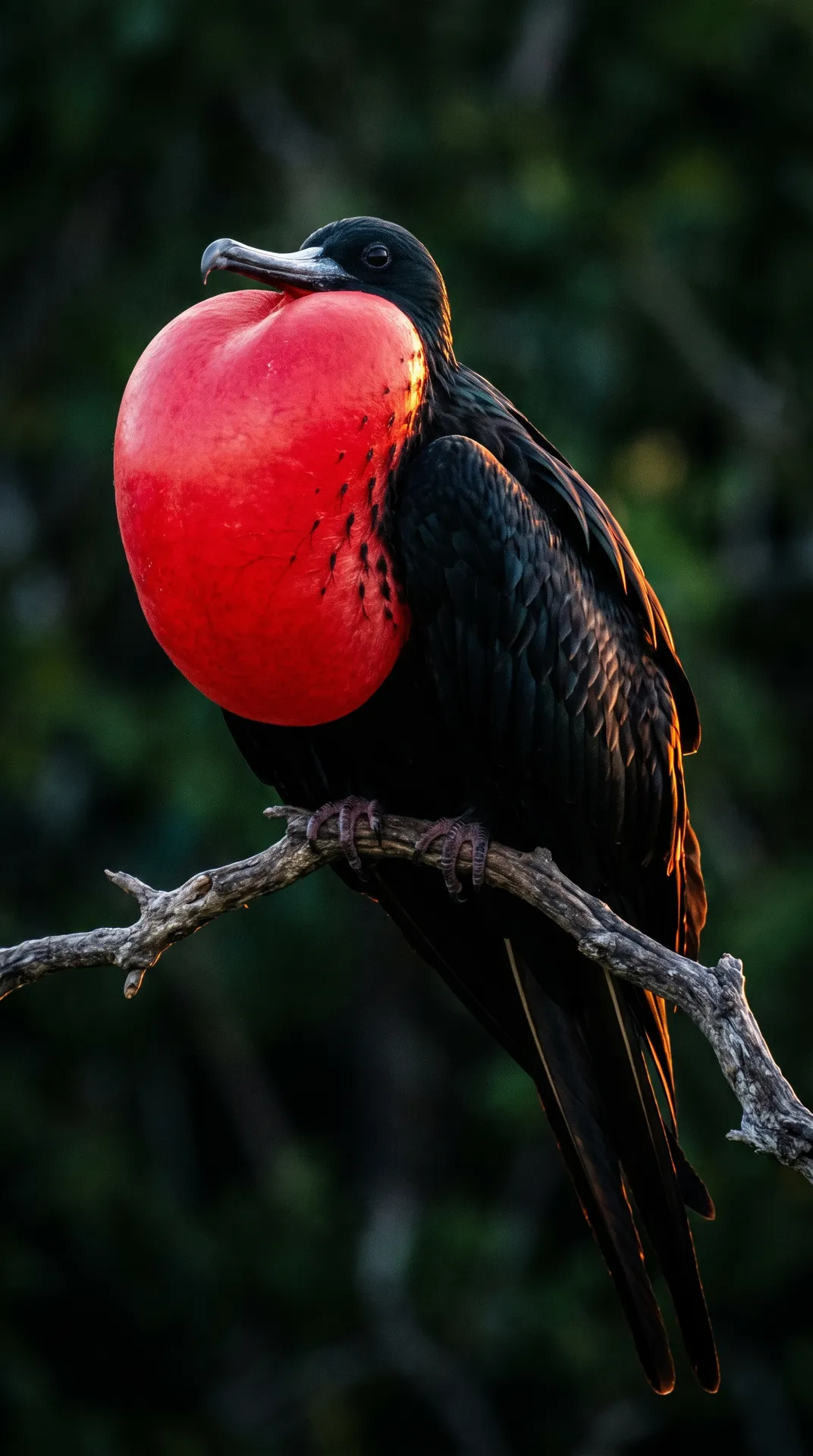
The seabird that inflates a giant red balloon to find love
To win a mate, this seabird inflates a giant red balloon on its throat for hours.
Which one is REALLY true about the Frigatebird?
The short version
The male frigatebird inflates a balloon-sized scarlet throat pouch for hours to attract mates. It can stay airborne for weeks or months without landing, sleeping mid-glide. As a seabird it can't land on water (its feathers aren't waterproof), so it steals food from other birds in midair.
Why it's so weird
- ✓The Frigatebird inflates a brilliant scarlet throat pouch the size of a balloon to win a mate.
- ✓The Frigatebird sits and drums on its red throat balloon for hours, hoping a female will pick it.
- ✓The Frigatebird can stay airborne for weeks, even months, without ever landing.
- ✓The Frigatebird sleeps in short bursts while it's still gliding high in the sky.
- ✓The Frigatebird can't land on water because its feathers aren't waterproof and it could drown.
The Frigatebird is about 1.9× as long as a 7-year-old! 🤯
The full story
To win a mate, this seabird blows up a giant red balloon right out of its throat. Meet the frigatebird, one of the most extreme fliers in the entire sky. During courtship, the male inflates a brilliant scarlet throat pouch the size of a balloon, then sits and drums on it for hours, hoping a female flying overhead will choose him. But the real superpower is flight. Frigatebirds can stay airborne for weeks, even months, without ever landing, riding warm currents miles high and sleeping in short bursts while still gliding. Strangely, for a seabird, they cannot land on water at all. Their feathers are not waterproof, so if they touch down on the sea, they can get waterlogged and drown. So instead, they often steal food in midair, chasing other birds until they drop their catch. Follow for more weird animal facts.
A frigatebird has huge wings but a super-light body, so it has more wing for its weight than any other bird. That means it doesn't have to tire itself out flapping. Instead it rides columns of warm rising air (called thermals) up high, then glides slowly downward until it catches the next one, using almost no energy. It even sleeps in tiny bursts of about ten seconds while gliding, sometimes resting only half its brain so it keeps flying steadily.
📚 Source: These Masters of the Sky Can Fly for Hours (or Days) While Barely Flapping — Audubon ↗Scientists attached tiny trackers to dozens of great frigatebirds that recorded each bird's location and movements, and the data showed them flying nonstop for weeks or even months without ever landing.
📚 Source: Frigate birds spend months without landing — Science News Explores ↗Watch the 45-second version
Watch it on the channel.
Frigatebird gallery


Check what you learned
No score, no pressure — just see what stuck. Tap Real or Fake.
“The Frigatebird inflates a brilliant scarlet throat pouch the size of a balloon to win a mate.”
“The Frigatebird keeps a dinner-plate-sized frill folded flat against its neck until something scares it.”
“The Frigatebird sits and drums on its red throat balloon for hours, hoping a female will pick it.”